
Alexander Zverev finally broke through at Grand Slam level in 2026, and he did it twice.
After years of knocking on the door, Zverev won both Roland Garros and the US Open. Taking his career tally from zero Grand Slam titles to two in the space of just a few months.
But alongside those victories came a familiar discussion among tennis fans: how difficult were the paths he actually had to navigate?
The argument was that Zverev had benefited from relatively favorable draws and avoided many of the strongest possible opponents on his way to both titles.
That raised an interesting question: can we quantify the difficulty of a Grand Slam title run using the Tennis AIQ historic database?
And if we can, how do Zverev’s two championship runs compare to those of every other Grand Slam champion over the past 15 years?
That is what we set out to measure.
First, an important distinction
Before diving into the numbers, one thing should be made clear: every Grand Slam title is earned.
Players have no control over who appears on the other side of the net. They can only face the opponents their draw puts in front of them. And ultimately, winning a Grand Slam means being the last player standing.
This analysis is therefore not an attempt to determine which titles carry bigger or less value.
Instead, it asks a much narrower question: how difficult was the path each champion had to navigate?
Measuring 15 years of Grand Slam title runs
We analyzed every men’s Grand Slam champion from 2012 through 2026.
With Wimbledon not being played in 2020, that leaves us with 59 Grand Slam tournaments, and therefore 59 championship paths.
Each path consists of seven rounds and potentially seven different opponents.
Simply looking at the ATP ranking of those opponents would not tell the whole story. A player’s strength can differ significantly by surface, while ATP rankings also do not necessarily capture a player’s exact level at a specific moment in time.
Instead, we used the historical Tennis AIQ Skill Rating of every opponent immediately before the match took place, specific to the surface being played.
But another problem remains.
Comparing the actual probability of different champions completing their paths would also depend on how strong of a player the champion was himself. A path that was difficult for one player might have been considerably easier for another.
So we removed that variable.
Introducing the reference player
For every one of the 59 championship runs, we replaced the actual champion with exactly the same hypothetical player: a 1640-rated reference player.
A Skill Rating of 1640 represents approximately the level of a player who consistently belongs among the top three players in the world.
This means that whether the actual champion was Novak Djokovic, Rafael Nadal, Roger Federer, Stan Wawrinka, Carlos Alcaraz or Alexander Zverev, the player attempting the path in our calculation was always identical.
The opponents, however, remained exactly as they were historically. For each match, the opponent retained his actual surface-specific Skill Rating immediately before that particular match.
This puts all 59 championship paths on a common reference scale.
Reference Player Path Probability
Using the same win-probability method as the Tennis AIQ Prediction Engine for Grand Slam best-of-five matches, we calculated the probability that our 1640-rated reference player would beat each opponent.
That gives us seven individual win probabilities.
We then multiply those probabilities:
The result is what we call the Reference Player Path Probability (RPPP).
In simple terms, RPPP is the probability that a fixed 1640-rated reference player would successfully navigate the champion’s exact path to the title.
The lower the RPPP, the more difficult the path.
A 50% RPPP means our reference player would have a relatively strong chance of surviving that particular route. A 3% RPPP means that completing the same path would be an exceptionally difficult task — even for a player of consistent top-three quality.
For matches won via retirement or walkover, we assign a win probability of 100%. In other words, those matches do not reduce the RPPP.
This also means the metric measures the difficulty of the opposition, rather than the physical effort required during the tournament. A match ending in retirement is treated as a 100% win for the purpose of the path calculation, regardless of how much tennis had already been played.
From probability to a Difficulty Score
To make the results easier to interpret, we convert RPPP into a Difficulty Score from 1 to 10.
An RPPP of 50% corresponds to a Difficulty Score of 1, while an RPPP of 3% corresponds to a Difficulty Score of 10.
We first calculate:
and then:
Scores are limited to the 1–10 range. An RPPP above 50% receives a score of 1, while an RPPP below 3% receives a score of 10.
The Difficulty Score does not introduce a second measure of difficulty. It is simply a more intuitive representation of the underlying RPPP.
And with that, we can rank all 59 paths.
59 Grand Slam titles, ranked by path difficulty
| Rank | Year | Grand Slam | Champion | RPPP | Difficulty |
|---|---|---|---|---|---|
| Loading rankings... | |||||
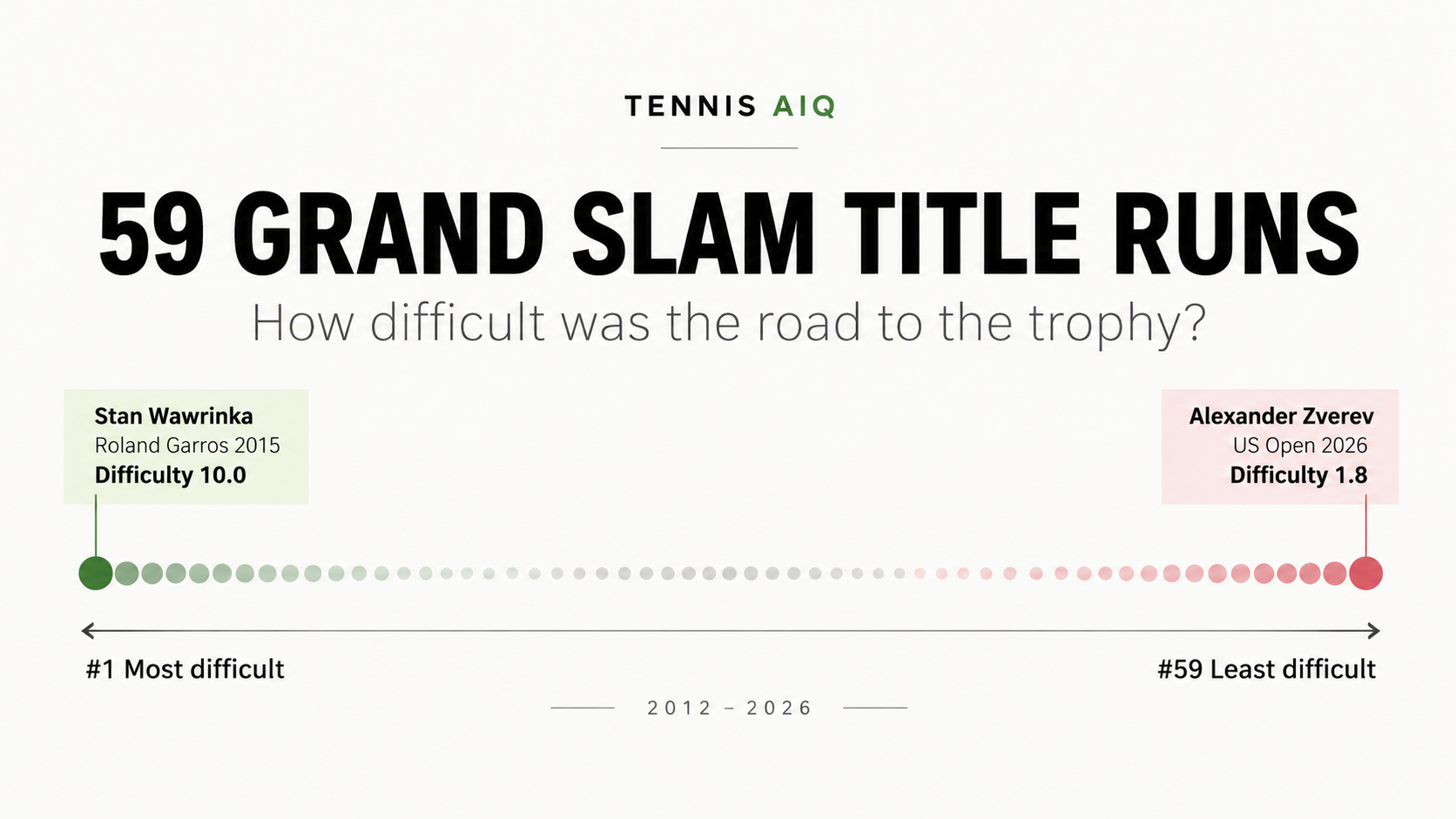
At the top of the list is Stan Wawrinka’s 2015 Roland Garros title.
A 1640-rated reference player would have had only a 2.6% chance of successfully navigating Wawrinka’s path, resulting in the maximum Difficulty Score of 10.0.
At the very bottom of the ranking, however, we find the two runs that originally inspired this analysis.
So, how difficult were Zverev’s 2026 Grand Slam runs?
Zverev’s Roland Garros title ranks 58th out of 59, with an RPPP of approximately 33.0% and a Difficulty Score of 2.3.
His US Open title ranks 59th, with an RPPP of approximately 39.1% and a Difficulty Score of just 1.8.
According to our model, they are therefore the two least difficult paths among all 59 Grand Slam title runs in our 2012–2026 dataset.
That does not mean Zverev was undeserving of either title. Nor does it tell us how well he played during those tournaments.
It tells us something much more specific: the opposition standing between Zverev and those two trophies was relatively favorable compared with the paths Grand Slam champions have faced over the past 15 years.
And there is an interesting comparison at the exact opposite end of our ranking.
Wawrinka and Zverev: two very different paths to Grand Slam glory
Stan Wawrinka and Alexander Zverev make for an interesting comparison.
Both established themselves among the very best players of their respective eras, while competing alongside an even more dominant group at the very top.
For Wawrinka, that meant playing during the era of Federer, Nadal and Djokovic. For Zverev, his breakthrough Grand Slam season came in an era increasingly defined by Jannik Sinner and Carlos Alcaraz.
Both men found a way to become multiple Grand Slam champions.
But according to our model, the paths they took could hardly have been more different.
Wawrinka’s three Grand Slam championship runs rank 1st, 6th and 22nd among the 59 paths in our dataset.
His 2015 Roland Garros title received a Difficulty Score of 10.0, his 2014 Australian Open title 8.5, and his 2016 US Open title 6.5.
Zverev’s two championship runs, meanwhile, occupy the final two positions: 58th and 59th, with Difficulty Scores of 2.3 and 1.8.
Perhaps the clearest illustration comes from comparing the two extremes of the entire dataset: Wawrinka’s 2015 Roland Garros run and Zverev’s 2026 US Open run.
Wawrinka 2015 vs. Zverev 2026
Stan Wawrinka
Roland Garros 2015
| Round | Opponent | Rating |
|---|---|---|
| R128 | Marsel Ilhan | 1556 |
| R64 | Dusan Lajovic | 1592 |
| R32 | Steve Johnson | 1573 |
| R16 | Gilles Simon | 1601 |
| QF | Roger Federer | 1643 |
| SF | Jo-Wilfried Tsonga | 1632 |
| F | Novak Djokovic | 1684 |
Alexander Zverev
US Open 2026
| Round | Opponent | Rating |
|---|---|---|
| R128 | Lorenzo Sonego | 1575 |
| R64 | Quentin Halys | 1575 |
| R32 | Alejandro Tabilo | 1584 |
| R16 | Luciano Darderi | 1575 |
| QF | Botic van de Zandschulp | 1595 |
| SF | Karen Khachanov | 1599 |
| F | Ben Shelton | 1623 |
Wawrinka’s 2015 Roland Garros path culminated in a quarterfinal against Roger Federer and a final against Novak Djokovic, with Djokovic carrying a surface-specific Skill Rating of 1684 at the time.
Zverev’s 2026 US Open path, by contrast, produced an RPPP of 39.1%.
Put differently, the exact same 1640-rated reference player was roughly 15 times as likely to successfully complete Zverev’s US Open path as Wawrinka’s Roland Garros path.
Yet both paths ultimately ended in exactly the same place: with the player lifting a Grand Slam trophy.
What does a Grand Slam title path really tell us?
The purpose of this analysis is not to rewrite history or decide which Grand Slam trophies should count for more.
A champion cannot choose his draw.
Sometimes winning a major requires defeating several of the strongest players in the world. At other times, upsets elsewhere in the draw or injuries remove those players before the eventual champion ever has to face them.
The champion’s job remains the same: beat whoever is in front of you.
What the Reference Player Path Probability allows us to do is separate that question from the quality of the champion himself.
By sending the exact same hypothetical player through every historical path, we can quantify something that is usually discussed only subjectively: how much resistance was actually standing between the champion and the trophy?
For Alexander Zverev in 2026, the answer is striking. His two championship paths sit at the very bottom of our 15-year ranking.
For Stan Wawrinka, the opposite is true. All three of his titles came through above-average difficulty paths, including the most difficult championship run in the entire dataset.
Two multiple Grand Slam champions. Two very different routes to get there.